IN DEPTH
Two in-depth comparisons you ask about most
These two are the most frequent brand comparisons in overseas inquiries. Each is explained at length, with the boundary of each brand's strengths and the applications they fit best.
Inovance vs Siemens
Scope: VFD, small PLC, servo, HMI.
Inovance is one of the strongest Chinese players in industrial automation, with a product line spanning VFDs, servos, PLCs and HMIs. In general drives (fans, pumps, conveyors), equipment automation and low-to-mid power applications, Inovance already meets most requirements — typically 30–50% cheaper than Siemens equivalents, and with shorter lead times.
Siemens' strengths are concentrated in high-end and complex applications: large/complex PLC systems (S7-1500 and above), complex motion control, high-power drives, and projects with very high requirements on long-term reliability and global service. Here, Siemens' maturity, ecosystem and brand recognition still have a clear edge — keep them.
Selection call: For general drives and equipment automation, Inovance is the cost-effective choice; for complex motion control, large system integration or projects where the end client specifies the brand, keep Siemens. The two are not a one-for-one swap — communication architecture (such as deep Profinet integration) and program migration cost must be assessed together.
Read the full MD200/MD520/MD580 vs SINAMICS V20/G120C/G120 comparison →
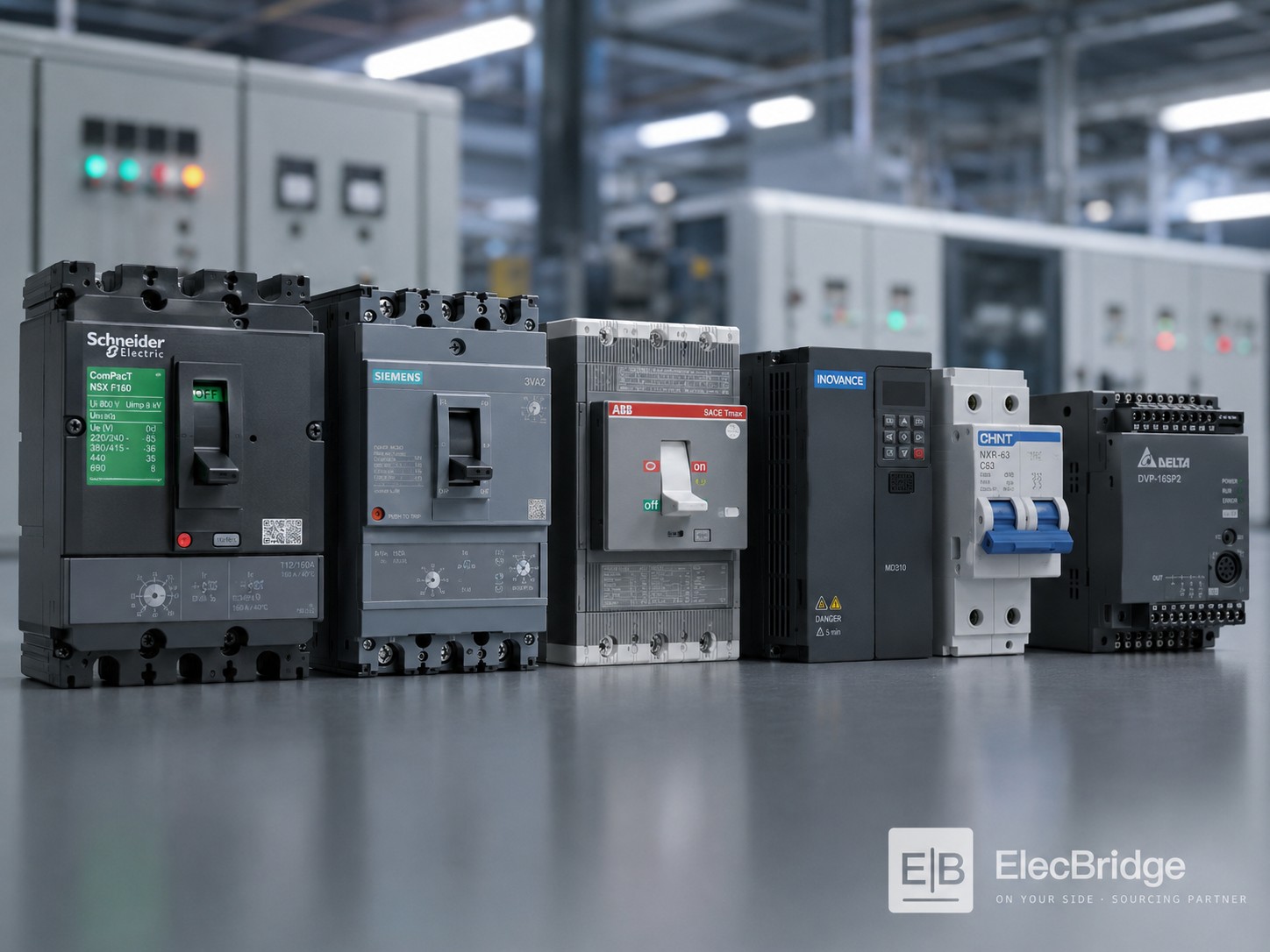
CHINT vs Schneider
Scope: low-voltage breakers, contactors, relays and other LV electrical components.
CHINT is the leader in Chinese low-voltage electrical components. On branch breakers, final distribution, contactors and relays, products are mature, supply is stable, and pricing is typically 40–60% below Schneider equivalents. For the branch and accessory positions used in large quantities inside a control panel, CHINT is a widely-proven, cost-effective choice.
Schneider's strengths are concentrated on main incomers, main protection and high-breaking-capacity applications, as well as high-end industrial and export projects where brand acceptance matters. On main breakers and high short-circuit current loops, strictly verify breaking capacity (Icu/Ics) — generally keep Schneider here, or select the top-tier Chinese option.
Selection call: Do not replace the whole panel wholesale. The right approach is to work in layers: stay conservative on critical positions (main incomer, main protection), and prioritize CHINT on standardized parts (branch breakers, contactors, buttons, terminals). This typically brings overall panel cost down 15–30% without compromising acceptance or safety.
Read the full NXB-63/NM8N/NC1/NXC vs Acti9/ComPacT/TeSys comparison →
— GET STARTED
Want a targeted brand comparison?
Send us the brands you're using or considering, with the application — within 48–72 hours you get an unbiased comparison and selection recommendation. Switch what should switch, keep what should stay — we'll say it straight.
Get a targeted comparison →
WhatsApp:+86 189 9841 9159 · sales@elecbridge.com